Music streaming has made it easier than ever to access millions of songs. With a smartphone, a subscription, and a network connection, listeners can explore almost any genre within seconds. So, in 2026, does buying a dedicated CD player still make sense?
For many music lovers, the answer is yes. CDs offer something that streaming services do not always provide in the same way: physical ownership of an album, consistent access to a personal music collection, and a dedicated playback experience without depending on an internet connection or subscription.
That does not mean a CD player is the right choice for everyone. If you mainly listen to playlists, discover new music through streaming apps, or prefer a minimal setup, a network music player may be more convenient. But if you own a CD collection, enjoy listening to complete albums, or want a dedicated source component for a Hi-Fi system, a CD player remains a practical option.
Tonewinner's current product lineup includes the TY-1CDPRO Hi-End CD player, the multifunctional AD-89D integrated CD amplifier, and the TY-i2PRO streaming music player. Each serves a different listening preference. This guide looks at whether CD players are still worth buying in 2026, what to consider before choosing one, and how these Tonewinner products fit into a modern home audio system.
Yes, a CD player can still be worth buying in 2026 if you value physical music collections, reliable playback, and a dedicated Hi-Fi source. The format may no longer be the default choice for everyday listening, but it continues to serve a clear purpose for people who own CDs and want to enjoy them through a home audio system.
There are several reasons why listeners continue to choose CD playback:
For listeners who already own a substantial CD collection, buying a quality player is not necessarily a step backward. It can simply be a way to make better use of music they already own.
The more useful question is not whether CDs are old or new. It is whether physical playback matches the way you actually enjoy music.
CDs and streaming services are not direct replacements for one another. They offer different advantages, and the better option depends on convenience, ownership, music availability, and the equipment in your system.
| Comparison | CD Playback | Music Streaming |
|---|---|---|
| Music access | Limited to discs you own or borrow | Large online catalogues, depending on the service |
| Internet required | No | Usually, unless offline playback is available |
| Ownership | Physical disc ownership | Access governed by the service and subscription terms |
| Convenience | Requires changing discs | Easy searching, playlists, and remote control |
| Audio quality | Standard CD audio is 16-bit/44.1kHz PCM | Varies by service, subscription, and selected format |
| Listening experience | Physical albums and dedicated playback | Flexible access and discovery |
It is important to separate audio quality from the playback format itself. A CD uses uncompressed 16-bit/44.1kHz PCM audio. A streaming service may offer lossy compressed audio or lossless high-resolution formats, depending on its plan and catalogue.
However, a higher sample rate does not automatically mean better sound. The recording master, mastering quality, digital-to-analog conversion, playback electronics, and the rest of the audio system all matter.
For listeners who want both physical discs and online music, there is no need to choose only one. A dedicated CD player and a network music player can work together in the same Hi-Fi system.
A dedicated CD player is designed to read optical discs and deliver an audio signal to the rest of the system. Depending on its design, it may include its own digital-to-analog converter, analog output circuitry, digital outputs, and a dedicated power supply.
These elements matter because a CD player is not simply a disc drive. Its mechanical transport, digital signal processing, clocking, power supply, and analog output stage all contribute to how it operates within a Hi-Fi system.
When comparing CD players, pay attention to the following features:
A dedicated player is particularly useful when you already have a separate amplifier and speakers and want a source component focused on disc playback.
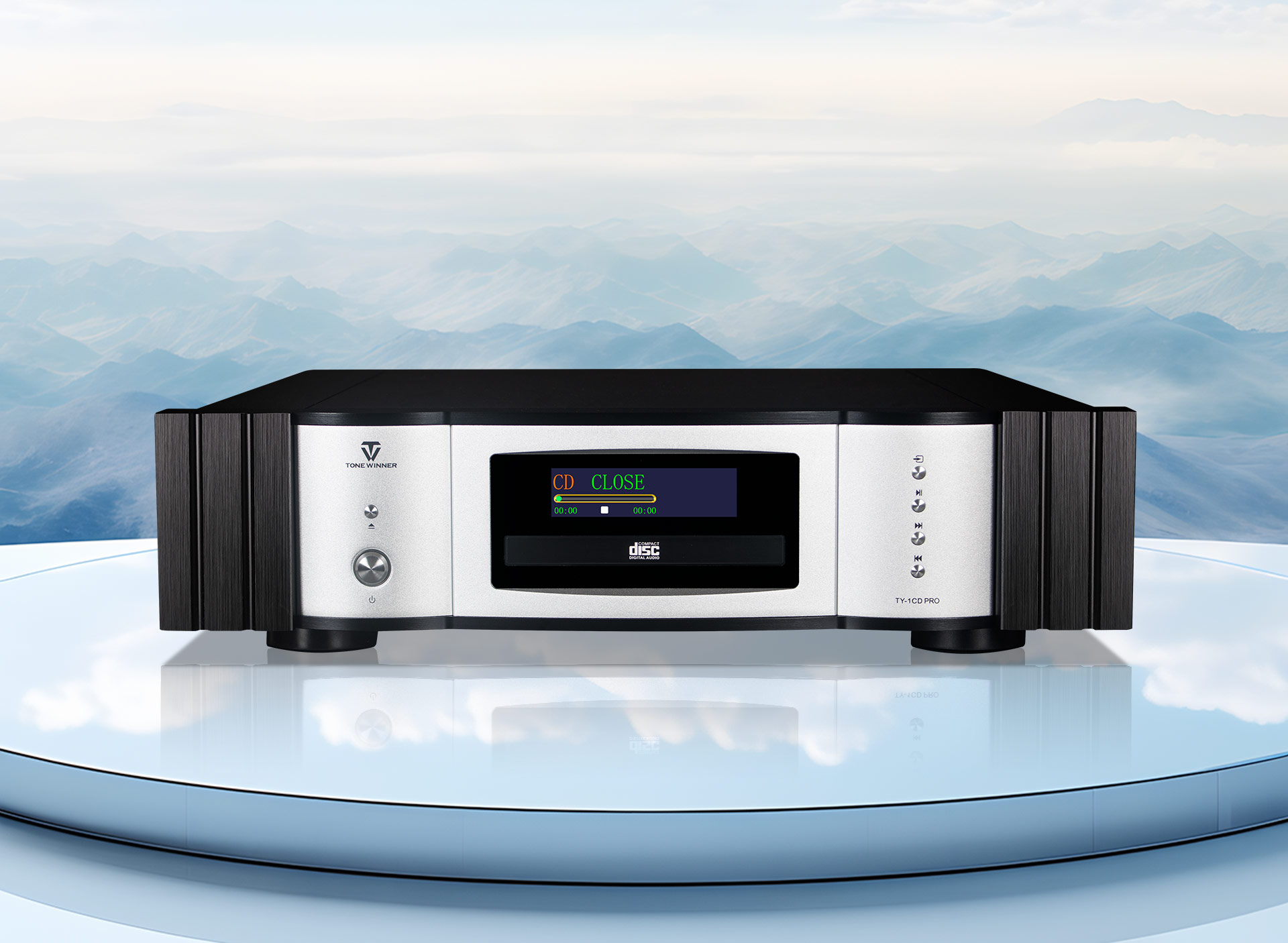
Tonewinner TY-1CDPRO Hi-End CD player
For listeners who want a dedicated disc player rather than an all-in-one music system, the Tonewinner TY-1CDPRO Hi-End CD player is the main model to consider.
The TY-1CDPRO is designed as a high-end CD player with both analog and digital outputs. Its published supported formats include CD, HDCD, MP3, and WMA. The product uses an ES9038 DAC, OPA1656 operational amplifiers, and a magnetic-levitation disc mechanism.
One of its key design features is a separated-chamber structure. The power supply and mechanical components, D/A converter, and transformer are housed in different shielded compartments. This layout is intended to reduce interference between different sections of the player.
The TY-1CDPRO also provides a range of connection options for different system configurations:
According to Tonewinner's published specifications, the TY-1CDPRO has a signal-to-noise ratio of at least 123dB on balanced output, total harmonic distortion of no more than 0.001% under the stated test condition, and a frequency range of 20Hz–20kHz (±0.1dB).
The player also supports internal high-rate digital processing up to 768kHz/32-bit. This should be understood as a capability of its decoding and processing architecture, not as a change to the native resolution of a standard CD recording, which remains 16-bit/44.1kHz PCM.
For someone who owns a large CD collection and already has a separate Hi-Fi amplifier, the TY-1CDPRO provides a dedicated source component with both analog and digital connection flexibility.
Not necessarily. A separate CD player and amplifier give you more freedom to choose and upgrade individual components, but they also require more equipment, cables, and space.
If you prefer a simpler setup, an integrated CD amplifier can combine several functions in one chassis. This approach can be especially practical for a living room, study, or compact stereo system.
The important question is how much flexibility you need. A dedicated player makes sense if you already own an amplifier or want to build a component-based system. An integrated CD amplifier may be more suitable if you want to connect speakers and start listening without assembling several separate devices.
If you want CD playback without building a system from separate components, the Tonewinner AD-89D integrated amplifier is another option from the promoted product lineup.
The AD-89D combines several functions in one device:
It also supports USB and TF card playback, USB Audio for PC, optical and coaxial digital inputs, and HDMI ARC for compatible televisions. Its subwoofer output allows users to build a 2.1-channel system when a powered subwoofer is added.
The official product specifications list two channels of amplification, with 130W per channel at 8 ohms under the stated test conditions. Its rated impedance is 8 ohms, and the product includes both analog and digital source connections.
This makes the AD-89D worth considering for listeners who want to play CDs, connect a computer or television, and drive a pair of passive speakers without buying a separate CD player, DAC, preamplifier, and power amplifier.
There is a trade-off. An all-in-one component reduces system complexity, while separate components provide more freedom to upgrade the source, DAC, and amplifier independently. Neither approach is automatically better; the right one depends on your room, budget, and upgrade plans.
If you rarely buy CDs and mainly listen through online services, a network music player may be a better first purchase. It gives you access to digital libraries, network storage, and supported streaming applications without requiring you to handle physical discs.
On the other hand, if you already own many albums on CD, a dedicated CD player provides a straightforward way to enjoy that collection. The two approaches can also complement each other: one handles physical discs, while the other manages streaming and locally stored files.

Tonewinner TY-i2PRO high-end streaming music player
The Tonewinner TY-i2PRO streaming music player is designed for listeners who want a more connected digital music experience.
It supports Wi-Fi 6 and wired network connections, local playback from hard drives, USB storage and TF cards, and access to network storage through supported protocols. Its format support includes DSD, FLAC, WAV, AIFF, ALAC, APE, MQA, and other common digital audio formats.
One particularly useful feature is its support for external USB optical drives. With a compatible external drive, the TY-i2PRO can play CDs and perform lossless CD ripping, allowing tracks to be saved to local storage. The external optical drive must be supplied separately.
This makes the TY-i2PRO an interesting alternative for people who want to keep their CD collection but also build a digital music library. Instead of relying on a traditional dedicated CD player for every listening session, users can rip discs and manage their music files through the network player.
For listeners who value both physical music and digital convenience, the choice does not have to be either CD or streaming. A combination of a dedicated player and a network source can cover both needs.
A CD player is only one part of a stereo system. To get the most from it, you also need an amplifier, suitable speakers, and the right connections between components.
A basic system can be built in several ways.
Dedicated CD player and integrated amplifier: Connect the CD player's analog outputs to an available line-level input on the amplifier. The amplifier then drives the passive speakers. This is a flexible option for users who want separate components.
CD player using an external DAC: If you prefer a separate DAC, connect the CD player's optical, coaxial, or AES/EBU output to a compatible digital input on the DAC. The DAC then connects to the amplifier.
Integrated CD amplifier: A multifunction model such as the AD-89D combines disc playback, decoding, and amplification. Connect the speakers directly to the amplifier's speaker terminals and select the appropriate input for other sources.
When choosing speakers, consider sensitivity, impedance, room size, and listening distance. A suitable amplifier and speaker combination matters more than simply choosing the most expensive component.
For a component-based stereo system, explore the Tonewinner Hi-Fi amplifier range and compare the available integrated and separate amplification options.
If you are still choosing speakers, the Tonewinner Hi-Fi speaker range provides additional options for building a matching two-channel system.
The three promoted models discussed in this guide are designed for different listening needs. The following comparison can help narrow down the options.
| Model | Product Type | Main Features | Best Suited To |
|---|---|---|---|
| TY-1CDPRO | Dedicated CD player | ES9038 DAC, analog and digital outputs, balanced XLR, AES/EBU | CD collectors and component-based Hi-Fi systems |
| AD-89D | Integrated CD amplifier | CD playback, digital playback, decoding, stereo amplification, HDMI ARC | Users who want a simpler all-in-one stereo system |
| TY-i2PRO | Network music player | Wi-Fi 6, NAS, local storage, high-resolution formats, external CD ripping | Streaming listeners and digital music library users |
If you mainly play physical CDs and already own an amplifier, start by comparing the TY-1CDPRO with your current source component. If you want CD playback and amplification in one chassis, consider the AD-89D. If your listening habits are centered on network streaming and local music files, the TY-i2PRO may be a more natural fit.
These products are not simply different price levels of the same device. They serve different roles in a music system, so choosing according to your listening habits is more useful than comparing specifications in isolation.
Before purchasing a CD player, consider how it will fit into your existing system. A few practical checks can prevent compatibility problems and unnecessary upgrades.
It is also worth considering whether you want to keep buying CDs. If your collection is growing and you enjoy owning physical albums, a dedicated player can remain useful for many years. If you rarely purchase discs, a streaming or network music player may provide more everyday value.
Yes, a CD player is still worth buying in 2026 for listeners who own physical albums, value music collection ownership, and enjoy a dedicated Hi-Fi playback experience. The format may not offer the convenience of modern streaming, but it continues to serve a clear purpose in a well-planned home audio system.
For a dedicated CD source, the Tonewinner TY-1CDPRO offers analog and digital output flexibility, an ES9038 DAC, and a separated-chamber design. For listeners who want disc playback and amplification in one component, the AD-89D combines CD playback, digital decoding, and stereo amplification. For users who prefer streaming and local music libraries, the TY-i2PRO provides a more network-oriented approach and can also rip CDs through a compatible external optical drive.
The best choice depends on how you listen to music. If you enjoy physical albums, a CD player is still a worthwhile addition. If convenience and online discovery matter more, a network music player may be the better starting point. And if you want both, a modern Hi-Fi system can accommodate both sources.
Rather than treating CD and streaming as competing formats, think about which source gives you the most enjoyable and practical listening experience. That is the best way to decide whether a CD player deserves a place in your system.
Yes. CD players remain useful for people who own physical music collections, prefer offline playback, and want a dedicated source for a Hi-Fi system. They are less necessary for listeners who rely almost entirely on streaming services.
Not automatically. Standard CD audio uses 16-bit/44.1kHz PCM, while streaming services offer different audio formats and quality levels. The recording master, mastering quality, DAC, playback equipment, and listening environment all influence the final sound.
A CD player reads physical discs and sends audio to an amplifier or DAC. A network music player accesses music through streaming services, network storage, or local digital files. Some network players, including the Tonewinner TY-i2PRO, can also play and rip CDs when connected to a compatible external USB optical drive.
The official product information lists CD, HDCD, MP3, and WMA support. The player also provides analog RCA and XLR outputs, along with optical, coaxial, and AES/EBU digital outputs.
Yes. Its optical, coaxial, and AES/EBU digital outputs allow connection to a compatible external DAC or digital audio component. This is useful for listeners who want to use a separate digital-to-analog converter in their Hi-Fi system.
Yes. The AD-89D combines CD playback, digital music playback, decoding, and stereo power amplification in one integrated device. It also supports USB and TF card playback, Bluetooth, PC USB Audio, digital inputs, and HDMI ARC.
Yes, when connected to a compatible external USB optical drive. The TY-i2PRO supports CD playback and lossless CD ripping through an external drive, which must be supplied separately. Ripped tracks can be saved to local storage.
Usually, yes. A dedicated CD player sends an analog or digital audio signal to another component. To drive passive speakers, you need a suitable integrated amplifier or preamplifier and power amplifier combination. An integrated CD amplifier such as the AD-89D includes the amplification stage.
Choose a CD player if you own discs and want dedicated physical playback. Choose a network music player if you mainly use streaming services, NAS libraries, or local digital files. If you use both formats regularly, a system with separate CD and network sources can provide the most flexibility.
Tel : +86 020 3479 6146
Tel : +86 020 3479 7660
WhatsApp : +86 15812388120
Email : simi@tonewinner.com
Address : Building 2, No.1, Hongsheng 3 Road Dashi Street, Panyu District Guangzhou, 511430 China
© 2026 Guangzhou Tonewinner Electronics Co., Ltd
Sitemap | XML | Privacy Policy |