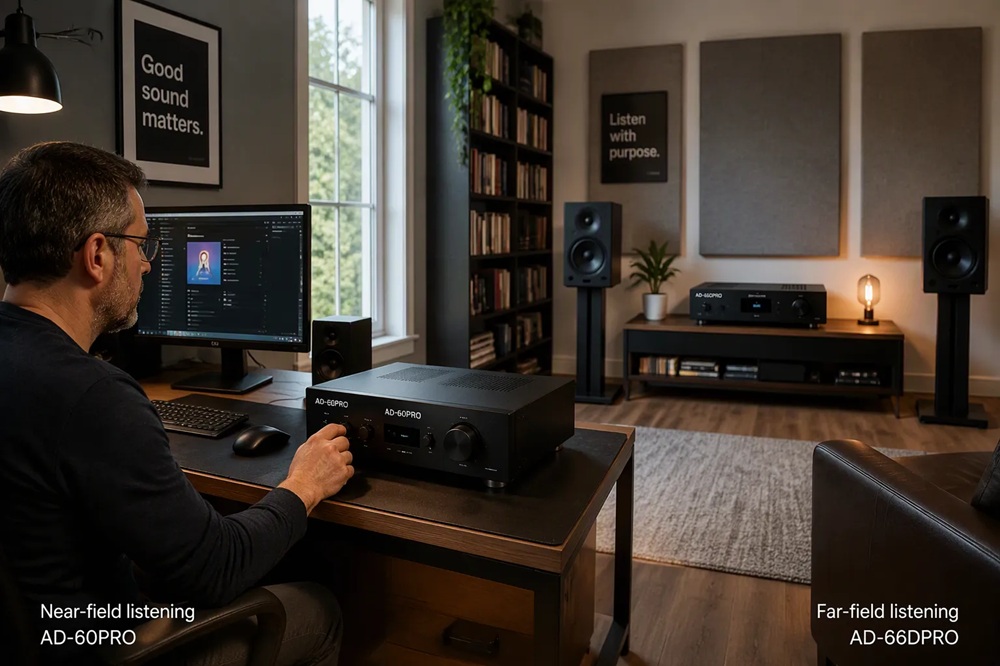
Your first Hi-Fi amplifier should match your room, not a spec sheet. For a near-field desktop setup, choose the Tonewinner AD-60PRO Class AB Mini Hi-Fi Amplifier. For a far-field living room, choose the AD-66DPRO. Listening distance and room size guide this decision. Both Tonewinner amplifiers suit first-time buyers well.
Near-field listening places you close to your speakers, typically around 1 meter away. At this distance, direct sound dominates. Room reflections play a minimal role. Professional audio guidelines recommend a minimum listening distance of 1 meter from each speaker. You should also form an equilateral triangle between the left speaker, right speaker, and your head. This geometry delivers a consistent stereo image and precise detail. Desktop monitors and computer workstations rely on this setup. You hear the speaker, not the room.
Far-field listening moves you much farther back, often several meters across a living room or dedicated listening space. You hear a blend of direct sound and reflected energy from walls, floor, and furniture. The room becomes part of the performance. This distance changes the amount of amplifier power you need. The inverse-square law applies: as distance doubles, sound pressure level drops by about 6 dB. To compensate, your amplifier must deliver significantly more power.
Your listening distance directly determines the power required from an amplifier. For example, a speaker with 86 dB sensitivity needs only 48 watts per channel at 8 feet to reach a moderate 80 dB with headroom. Move that listener to 15 feet, and the same speaker demands substantially more power to hold a higher listening level. The table below illustrates this principle:
|
Speaker Sensitivity |
Listening Distance |
Target SPL |
Amplifier Power Needed |
|
86 dB |
8 ft (2.46 m) |
80 dB |
48 W |
|
86 dB |
15 ft (4.6 m) |
90 dB |
1681 W |
As Chuck Hawks notes, required power increases with distance. Near-field desks let you use a compact amplifier like the Tonewinner AD-60PRO. Far-field rooms demand the higher current reserves of an integrated amplifier like the AD-66DPRO. Match the power stage to your actual listening distance, not to a spec sheet.
The Tonewinner AD-60PRO and AD-66DPRO serve different listening environments. Each amplifier brings distinct strengths to your setup. Understanding these differences helps you match the right amplifier to your room.
The AD-60PRO Class AB Mini Hi-Fi Amplifier targets desktop listeners who sit close to their speakers. Its Class AB design delivers clean, efficient power for near-field monitoring. You get detailed sound reproduction at low to moderate volumes. This amplifier shines when you work at your computer or edit audio at a desk.
The compact form factor makes the AD-60PRO Class AB Mini Hi-Fi Amplifier a natural fit for tight spaces. The unit measures 300 × 335 × 83 mm (W×D×H). That 300 mm width fits comfortably on most desks without crowding your monitor or keyboard. You gain a dedicated headphone amplifier with a 3.5mm output. This feature lets you switch to private listening without unplugging your speakers. The FAQ on the official Tonewinner page confirms analog input support through RCA connections. Retailer listings also describe the AD-60 Pro as a headphone amplifier integrated into the unit. You connect your computer, DAC, or CD player through the RCA analog input and output. The AD-60PRO Class AB Mini Hi-Fi Amplifier gives you a complete near-field system in a small footprint.
|
Feature |
AD-60PRO Support |
|
Headphone output |
3.5mm headphone amplifier with high-fidelity design |
|
RCA/analog input |
Analog input listed among supported audio sources |
|
Compact width |
300 × 335 × 83 mm (W×D×H) |
The AD-66DPRO takes a different approach. This Class A integrated amplifier delivers the higher current and power reserves you need for far-field listening. Class A operation biases the output devices to conduct continuously. This design produces rich, warm sound with low distortion. The trade-off comes in efficiency, but the sonic benefits suit critical listening in a dedicated room.
You place the AD-66DPRO across the room from your speakers. It drives floor-standing towers or large bookshelf speakers with ease. The amplifier fills a living room or listening space with dynamic, full-range sound. You hear deep bass and clean highs at realistic volume levels. The AD-66DPRO handles the complex impedance loads that far-field speakers often present. This integrated amplifier gives you the headroom to reproduce crescendos and dynamic peaks without strain.
The table below summarizes the key differences between these two Tonewinner amplifiers. Use it to match the amplifier to your listening habits.
|
Category |
AD-60PRO |
AD-66DPRO |
|
Amplifier class |
Class AB |
Class A |
|
Best listening distance |
Near-field (about 1 meter) |
Far-field (2+ meters) |
|
Typical room |
Desktop, office, studio |
Living room, listening room |
|
Headphone output |
Yes (3.5mm) |
Varies by configuration |
|
Analog input |
RCA |
RCA |
|
Compact width |
300 mm |
Larger chassis |
|
Power delivery |
Moderate, efficient |
High current, high power |
|
Best for |
Desktop speakers, near-field monitors |
Floor-standing speakers, large rooms |
The AD-60PRO Class AB Mini Hi-Fi Amplifier prioritizes efficiency and compact size. You get clean power for close listening without excess heat or bulk. The AD-66DPRO prioritizes raw power and current delivery. You get the muscle to drive demanding speakers across a large room. Both amplifiers share Tonewinner's commitment to build quality and sound performance. Your choice depends on where you sit and how far your speakers stand from your ears.
Your listening distance settles the choice between these two amplifiers. Measure the space from your ears to the front of your speakers before you compare specs. Near-field setups place you about one meter away. Far-field setups put you two meters or farther back. Match the amplifier to that physical reality, and you will get the best sound for your money.
A desktop setting demands compact gear and precise control. You sit close to your speakers, often within arm's reach. At that distance, you need an amplifier that delivers clean power without wasting space or generating excessive heat. The Tonewinner AD-60PRO Class AB Mini Hi-Fi Amplifier fits this role perfectly. Its 300 mm width leaves room for your monitor, keyboard, and other desk essentials.
You gain a headphone amplifier with a 3.5mm output on the front panel. This feature lets you switch between speakers and headphones instantly. You can work late at night without disturbing anyone else in the room. The RCA analog input connects your computer, DAC, or CD player directly. You do not need a preamp or extra switching gear on your desk.
Near-field listening rewards detail and imaging more than raw volume. The AD-60PRO Class AB Mini Hi-Fi Amplifier delivers both with its efficient Class AB design. You hear subtle textures in vocals and precise placement of instruments at moderate listening levels. Your speakers work less because they sit close to your ears. You can run high-quality bookshelf monitors without straining the amplifier. This setup keeps your desk uncluttered while giving you accurate sound for work, gaming, or focused listening.
A living room or dedicated listening room changes the game entirely. You sit several meters away from your speakers. Your ears receive direct sound plus reflections from walls, floor, and furniture. That combination demands an amplifier with higher current delivery and more power headroom. The Tonewinner AD-66DPRO Class A integrated amplifier provides exactly that muscle.
Class A operation keeps the output devices fully conducting at all times. This design delivers a warm, rich tonal character and low distortion even at higher volumes. You can drive demanding floor-standing towers or large bookshelf speakers with confidence. The amplifier handles complex impedance curves that often appear in far-field speaker designs. Your music retains its composure during dynamic crescendos and deep bass passages.
You also benefit from the AD-66DPRO's larger chassis. Its internal power supply and heat management system support sustained output over long listening sessions. You set your speakers across the room, place the amplifier on a rack or stand, and enjoy a full-scale soundstage. This amplifier turns your room into the listening environment. It does not merely reproduce music; it energizes the entire space with convincing presence.
Use this guide to make a fast decision before you buy. The table matches listening distance and room type with the recommended amplifier.
|
Listening Distance |
Room Type |
Recommended Amplifier |
Typical Speaker Choice |
|
0.5 – 1.5 meters |
Desk, office, small studio |
AD-60PRO Class AB Mini Hi-Fi Amplifier |
Compact bookshelf or near-field monitors |
|
2 – 4 meters |
Living room, media room, listening room |
AD-66DPRO |
Floor-standing towers or large bookshelf speakers |
|
Beyond 4 meters |
Large open-plan room |
AD-66DPRO with efficient speakers |
High-sensitivity towers |
The rule stays simple: measure your eyes-to-speakers distance first. If that number is under 1.5 meters, the AD-60PRO serves you best. If it climbs past 2 meters, choose the AD-66DPRO.
Your room dimensions also matter. A small bedroom desk usually places you less than one meter from your speakers. A large living room often puts you three or more meters away. Match the amplifier to your actual listening position. This approach avoids the two common first-buyer mistakes: buying too little power for a large room or buying unnecessary power for a close desk setup. Either choice you make will sound better when it matches your space.
Speaker ratings determine whether your amplifier works well or struggles. Check two numbers before you buy: impedance and sensitivity. The table below shows how each rating affects your match.
|
Rating |
How It Affects Amp/Speaker Matching |
Practical Implication |
|
Impedance (ohms) |
Amps have a safe rated range, often 4–16 ohms. Low-impedance speakers draw more current. |
Keep the speaker's nominal impedance inside the amplifier's specified range. |
|
Sensitivity (dB/W/m) |
Higher sensitivity means less power is needed for the same volume. Doubling amp power adds only 3 dB. |
Use sensitivity to estimate whether a modest amp reaches your preferred levels. |
A good example pairs an NAD D3045 amplifier (60 W into 8 ohms) with KEF LS50 speakers (8 ohms, 85 dB sensitivity). Both sit at 8 ohms, so the amp never drives a load outside its rated range. The amp's power also falls within the speakers' 25–100 W recommendation. This workflow—checking impedance, power range, and sensitivity together—gives you a reliable first Hi-Fi match.
Think about expansion before you commit. A Tonewinner amplifier with preamp outputs or a subwoofer output supports later additions. Yamaha's Hi-Fi Starter Guide notes that connection options and system expandability are the biggest benefits of a two-channel system. A dedicated phono input lets you add a turntable later. Many modern turntables include a built-in phono preamp, so they work with any amp.
"...it should have been the perfect amp if it had a subwoofer output to be truly amazing." — This customer review of the A100 amplifier shows that a missing subwoofer output limits future upgrades.
Match amplifier power to your speaker's RMS rating, or go modestly higher. A common guideline suggests an amp rated at 1.5–2 times the speaker's RMS power. Treat extra power as headroom you rarely approach, not a new continuous listening level. Clean signals and restrained volume keep your system safe. A Tonewinner amplifier that fits your room and speakers delivers better value than one with unused power.
Sit close to your speakers at a desk? Choose the AD-60PRO Class AB Mini Hi-Fi Amplifier. Listen from across the room? Choose the AD-66DPRO.
Measure your listening distance and room dimensions before you buy. These numbers matter more than raw specs for a first Hi-Fi amplifier.
Either Tonewinner amplifier serves you well when it matches the room you actually listen in.
Choose the AD-60PRO Class AB Mini Hi-Fi Amplifier. Its compact 300 mm width fits tight spaces. You sit close to your speakers. This amplifier delivers clean near-field sound.
Yes, but you gain no benefit. The AD-66DPRO Class A integrated amplifier delivers high power for far-field rooms. A desktop setup wastes that capacity. Match your amplifier to your actual listening distance.
Measure from your ears to the front of your speakers. Under 1.5 meters means near-field. Past 2 meters means far-field. This number guides your Tonewinner amplifier choice.
Tel : +86 020 3479 6146
Tel : +86 020 3479 7660
WhatsApp : +86 15812388120
Email : simi@tonewinner.com
Address : Building 2, No.1, Hongsheng 3 Road Dashi Street, Panyu District Guangzhou, 511430 China
© 2026 Guangzhou Tonewinner Electronics Co., Ltd
Sitemap | XML | Privacy Policy |