What size subwoofer should you buy: 10, 12, or 18 inches? The answer depends on your room size, listening habits, desired bass output, and available space. A 10-inch subwoofer is often a practical choice for smaller rooms and everyday listening, a 12-inch subwoofer offers a versatile balance of deep bass and output for many home theaters, while an 18-inch subwoofer is designed for listeners who want substantial low-frequency output in larger rooms and dedicated home cinema environments.
However, a larger subwoofer driver does not automatically produce better sound. Amplifier power, driver excursion, enclosure design, frequency response, DSP processing, and room acoustics all influence actual performance. A well-designed 10-inch subwoofer can sound more controlled and satisfying than a poorly matched larger model.
Tonewinner offers several active subwoofer models across different performance levels, including the 10-inch SW-1000, 12-inch SW-D2000 and SW-D4000, and the 18-inch SW-D9000. Comparing these real products makes it easier to understand what different driver sizes can offer and which model may suit your home theater.
Subwoofer size usually refers to the nominal diameter of its bass driver, rather than the external dimensions of the entire cabinet. A 10-inch subwoofer uses a driver with a nominal diameter of approximately 10 inches, while 12-inch and 18-inch models use progressively larger drivers.
The driver moves back and forth to generate low-frequency sound waves. Generally, a larger driver can move more air, particularly when combined with sufficient excursion and an appropriate enclosure. This can help a subwoofer produce higher sound pressure levels and powerful bass at lower frequencies.
However, driver diameter alone cannot determine how deep or loud a subwoofer will play. Two subwoofers with the same driver size may perform very differently because of differences in motor strength, voice coil design, suspension, amplifier output, cabinet volume, and port tuning.
For this reason, when comparing subwoofers, look beyond the number printed on the driver. Pay attention to frequency response, RMS amplifier power, maximum output, distortion, and the manufacturer's actual specifications.
A 10-inch subwoofer is a good option for smaller living rooms, compact home theaters, desktop audio systems, and music-focused listening setups. It can add substantial low-frequency weight without requiring the cabinet space of a larger subwoofer.
For everyday movie watching, a capable 10-inch active subwoofer can reproduce bass effects such as background rumble, music impact, and many cinematic sound effects. It can also extend the low-frequency response of bookshelf or compact floorstanding speakers in a stereo system.
One of the main advantages of a 10-inch model is installation flexibility. Its smaller cabinet is generally easier to accommodate in a living room, and it can be a sensible choice when floor space is limited.
A practical example is the Tonewinner SW-1000, a 10-inch active subwoofer from the Storm Series. It features a long-excursion driver, front dual bass-reflex ports, and a Class H analog amplifier.
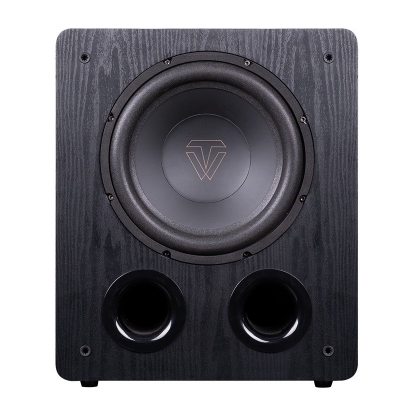
Its key specifications include 200W RMS amplifier output, 1000W peak power, and a frequency range of 21Hz to 240Hz. The cabinet measures 360 × 432 × 432mm, making it a relatively compact option within the Storm Series.
The SW-1000 also provides adjustable low-pass frequency, gain, and 0°/180° phase selection. Its front dual-port design offers more placement flexibility when the subwoofer needs to sit near a wall.
For listeners who want to improve the bass response of a compact home theater without installing an oversized cabinet, the Tonewinner SW-1000 10-inch active subwoofer is worth considering.
Choose a 10-inch subwoofer when compact dimensions, straightforward integration, and moderate-to-strong bass performance are more important than maximum output in a large cinema room.
For many home theater enthusiasts, a 12-inch subwoofer is the most versatile choice. It offers a useful balance between cabinet size, low-frequency extension, output capability, and installation requirements.
Compared with a typical 10-inch model, a 12-inch subwoofer has a larger cone area. With a suitable motor structure and sufficient excursion, this can help it move more air and deliver greater bass output. The difference becomes particularly noticeable when reproducing demanding movie soundtracks at higher listening levels.
A 12-inch subwoofer is suitable for many medium-sized living rooms, dedicated home theaters, and stereo systems where deeper bass and stronger dynamics are desired. It can also be a good upgrade for listeners who find that a smaller subwoofer struggles during demanding movie scenes.
Tonewinner offers two useful examples of this driver size: the SW-D2000 and SW-D4000. Although both use 12-inch drivers, their amplifier power and DSP features are different.

The SW-D2000 is a 12-inch DSP active subwoofer with 400W RMS amplifier output and 2000W peak power. Its published frequency range is 18Hz to 240Hz. It also supports mobile app control, multiple listening modes, phase adjustment, and seven-band EQ adjustment.
With its combination of power and DSP flexibility, the SW-D2000 is a strong option for users looking to build a more capable home theater while keeping cabinet dimensions manageable. Tonewinner has also discussed its suitability for living rooms measuring approximately 15 to 35 square meters, although actual performance depends on room construction, layout, and listening level.
You can find more technical details on the Tonewinner SW-D2000 12-inch DSP subwoofer product page.

For users who want more amplifier headroom from a 12-inch driver, the SW-D4000 is another option. It features an 800W RMS Class D amplifier, 4000W peak power, and a published frequency range of 16Hz to 240Hz.
Its built-in DSP provides seven-band parametric EQ, phase selection, low-pass adjustment, and selectable open or sealed port modes. It also supports mobile app control, an LCD touch display, XLR and RCA inputs, and wireless software updates.
This makes the SW-D4000 particularly interesting for home theater enthusiasts who want substantial output and more control over subwoofer integration. Its cabinet measures 440 × 533 × 558mm, so buyers should also consider the space required for installation.
For a closer look at its specifications and features, visit the Tonewinner SW-D4000 12-inch powered subwoofer product page.
If you are deciding between these two models, the main consideration is not their shared 12-inch driver size, but their different amplifier power, processing functions, cabinet construction, and intended performance level.
An 18-inch subwoofer is designed for users who demand substantial low-frequency output and a more powerful cinematic experience. It is particularly suitable for large dedicated home theaters, spacious entertainment rooms, and installations where strong bass performance at high playback levels is a priority.
Compared with smaller drivers, an 18-inch unit has a significantly larger cone area. When combined with suitable excursion, motor strength, amplifier power, and enclosure volume, it can move a considerable amount of air. This makes it especially useful for reproducing deep movie effects and demanding low-frequency content.
However, an 18-inch subwoofer is not automatically the right choice for every large room. It requires more physical space, and its output needs to be matched to the room, seating distance, and desired listening level. In smaller rooms, excessive output without proper calibration can result in unbalanced or overpowering bass.
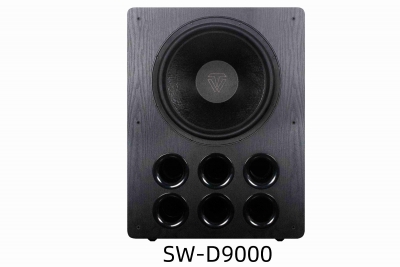
A representative model is the Tonewinner SW-D9000, an 18-inch DSP active powered subwoofer designed for high-output home theater applications.
The SW-D9000 features an 18-inch driver, a 1500W RMS Class D amplifier, and 8000W peak power. Its published frequency range is 11Hz to 200Hz, giving it an extended low-frequency specification for demanding cinema applications.
The model also features a built-in DSP processor, mobile app control, an LCD touch display, and a substantial MDF cabinet weighing approximately 87kg net. Its dimensions are 630 × 832 × 695mm, so installation space and floor support should be considered before purchasing.
For dedicated cinema enthusiasts seeking powerful low-frequency reproduction, the Tonewinner SW-D9000 18-inch DSP active subwoofer offers a high-output solution with extensive adjustment capabilities.
An 18-inch subwoofer makes the most sense when the room and the rest of the audio system can take advantage of its capabilities. It is not simply a larger version of a 12-inch subwoofer; it is intended for a different level of performance and installation.
The most useful way to compare subwoofer sizes is to look at actual models rather than assuming every driver of the same diameter performs identically.
| Specification | SW-1000 | SW-D2000 | SW-D4000 | SW-D9000 |
|---|---|---|---|---|
| Driver size | 10" | 12" | 12" | 18" |
| RMS power | 200W | 400W | 800W | 1500W |
| Peak power | 1000W | 2000W | 4000W | 8000W |
| Frequency range | 21–240Hz | 18–240Hz | 16–240Hz | 11–200Hz |
| Net weight | 19kg | 23kg | 34kg | 87kg |
| General application | Compact systems | Versatile home theaters | Higher-output home theaters | Large dedicated cinemas |
Specifications are based on Tonewinner's published product information. RMS and peak power are different measurements and should not be compared as equivalent continuous output ratings.
This comparison also highlights an important point: two 12-inch subwoofers can have very different capabilities. The SW-D4000 has twice the RMS amplifier output of the SW-D2000, while both share the same nominal driver diameter.
Likewise, the published low-frequency extension of the SW-D9000 reaches 11Hz, compared with 16Hz for the SW-D4000. These are manufacturer-specified frequency ranges; actual in-room response depends on measurement conditions, room acoustics, and playback level.
The comparison shows why choosing a subwoofer based only on driver size can lead to the wrong decision. Amplifier design, driver performance, DSP, enclosure engineering, and actual listening requirements all matter.
Room size is one of the most important considerations when selecting a subwoofer. A subwoofer must produce enough low-frequency energy to fill the listening space without being pushed beyond its comfortable operating range.
As a general starting point, consider the following recommendations:
| Listening Environment | Suggested Size | Main Consideration |
|---|---|---|
| Small bedroom or compact living room | 10 inches | Space efficiency and balanced output |
| Medium-sized living room | 10 or 12 inches | Desired bass level and room layout |
| Medium to large home theater | 12 inches | Output headroom and low-frequency extension |
| Large dedicated cinema room | 12 or 18 inches | High output and consistent bass coverage |
These recommendations are not strict room-size limits. A room with an open connection to another space may behave like a much larger listening environment. Ceiling height, wall construction, doors, windows, seating distance, and acoustic treatment can all affect the required subwoofer output.
For example, a 12-inch SW-D2000 may be sufficient for a medium-sized enclosed living room, while a larger open-plan space may benefit from a more powerful model or multiple subwoofers. The right choice should be based on the actual acoustic load rather than floor area alone.
Not necessarily. A larger driver can offer greater air displacement potential, but deep bass reproduction depends on the complete acoustic design of the subwoofer.
Several factors determine how low a subwoofer can reproduce sound:
A well-engineered 12-inch subwoofer can reproduce deeper bass than a poorly designed 18-inch model. The published frequency response of a product is therefore often more useful than driver diameter alone, although frequency response should also be evaluated alongside its stated measurement tolerance and output level.
Tonewinner's SW-D4000 is a good example of how DSP and enclosure design contribute to performance. Its built-in EQ, adjustable filters, phase selection, and selectable port modes allow users to adapt the subwoofer to different systems and listening environments.
Buying a larger subwoofer is not the only way to improve low-frequency performance. In some home theaters, two smaller subwoofers can provide more consistent bass distribution across several seats than one large subwoofer.
A single powerful subwoofer can be an excellent choice when the main listening position is the priority. However, bass response varies across a room because low-frequency sound waves interact with walls and other boundaries. This can create strong bass peaks in some seats and weak bass in others.
Using two subwoofers in carefully selected positions can help smooth these differences and improve bass consistency throughout the listening area. Their combined output may also provide additional headroom when the system is properly integrated.
The best solution depends on whether your main priority is maximum output at one seat or more even bass across a larger seating area. If you are considering a multi-subwoofer setup, read our guide on how many subwoofers a home theater really needs before making a decision.
Once you have selected a suitable driver size, compare the technical features that influence performance, installation, and long-term usability.
RMS amplifier power
RMS power is a more useful starting point than peak power when comparing continuous amplifier capability. Look at the specified impedance and test conditions as well, because power figures without these details can be misleading.
Frequency response
Check the lowest published frequency and, if available, the measurement tolerance. A frequency range without a stated response tolerance does not tell the complete story about how much output the subwoofer can deliver at its lowest frequencies.
DSP and equalization
DSP features can make subwoofer integration easier. Adjustable EQ, phase, low-pass filters, and listening modes are useful when adapting the bass response to the room and main speakers.
Connectivity
RCA and XLR inputs provide different connection options. Check compatibility with your AV receiver, processor, or stereo amplifier before purchasing. A subwoofer output can also be useful when expanding a system.
Cabinet size and weight
A powerful subwoofer needs suitable installation space. Consider cabinet dimensions, ventilation, access to power, cable routing, and whether the floor can safely support the product's weight.
If you are comparing different types of home audio equipment, the Tonewinner subwoofer and audio product range is a useful starting point for exploring available models and specifications.
If you are still unsure which size to choose, the following recommendations provide a straightforward starting point:
For most buyers who want a balance of performance, size, and versatility, a good 12-inch active subwoofer is an excellent place to start. It provides a wider performance range than many compact models without the installation demands of a large 18-inch cabinet.
However, if your room is small and your listening levels are moderate, there is no reason to buy a larger model simply because it has a bigger driver. Choose the subwoofer that matches your actual listening environment.
Explore the official Tonewinner audio product range to compare active subwoofers and build a home theater system that delivers the bass performance you need.
Is a 10-inch or 12-inch subwoofer better?
A 10-inch subwoofer is generally easier to accommodate in a smaller room, while a 12-inch model can offer greater air displacement potential and output when its design and amplifier support it. For many home theaters, a good 12-inch model provides an excellent balance between size and performance.
Is an 18-inch subwoofer too big for a living room?
Not necessarily, but an 18-inch subwoofer is physically large and can deliver substantial output. It is usually more suitable for spacious rooms and dedicated home theaters. In smaller living rooms, a properly selected 10-inch or 12-inch model may be easier to integrate.
Does a 12-inch subwoofer produce deeper bass than a 10-inch model?
Not automatically. Deep bass extension depends on driver excursion, enclosure design, amplifier capability, and tuning. Compare the published frequency response and measurement conditions of the actual models rather than relying on driver diameter alone.
What size subwoofer is best for a small room?
A 10-inch subwoofer is often a sensible starting point for a small room. However, a well-designed 12-inch subwoofer can also work when its output is properly adjusted and the cabinet can be accommodated.
What size subwoofer is best for a large home theater?
A powerful 12-inch or 18-inch subwoofer may be appropriate for a large home theater. The best option depends on room volume, seating distance, desired playback level, and whether one or multiple subwoofers will be used.
Is a higher wattage subwoofer always better?
No. Amplifier power is only one part of subwoofer performance. Driver sensitivity, excursion, enclosure design, distortion, frequency response, and DSP all affect the final result. RMS power should be considered alongside these specifications.
Is the Tonewinner SW-D4000 better than the SW-D2000?
The SW-D4000 has a higher amplifier rating, with 800W RMS compared with 400W RMS for the SW-D2000. Both use 12-inch drivers, but the SW-D4000 is designed for higher output and offers additional adjustment capabilities. The better choice depends on room size, budget, and listening requirements.
How low can the Tonewinner SW-D9000 play?
Tonewinner specifies a frequency range of 11Hz to 200Hz for the SW-D9000. Its actual output at the lowest frequencies will depend on measurement conditions, room acoustics, and playback level.
Should I buy one 18-inch subwoofer or two 12-inch subwoofers?
One 18-inch subwoofer may be preferable when maximum output at a primary listening position is the priority. Two 12-inch subwoofers may offer more flexibility for improving bass consistency across multiple seats. The result depends on the models, placement, and calibration.
Does a larger subwoofer consume more electricity?
Not always. Actual electricity consumption depends on amplifier efficiency, listening level, signal content, power supply design, and standby behavior. A larger subwoofer may have a more powerful amplifier, but it does not necessarily consume its maximum rated power during normal listening.
Tel : +86 020 3479 6146
Tel : +86 020 3479 7660
WhatsApp : +86 15812388120
Email : simi@tonewinner.com
Address : Building 2, No.1, Hongsheng 3 Road Dashi Street, Panyu District Guangzhou, 511430 China
© 2026 Guangzhou Tonewinner Electronics Co., Ltd
Sitemap | XML | Privacy Policy |