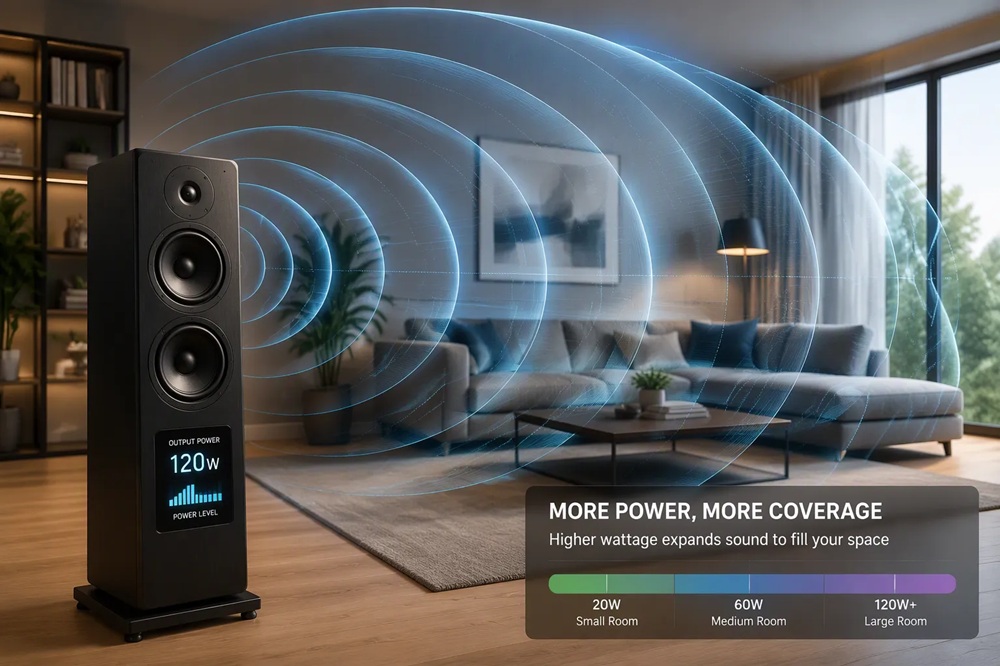
Most rooms need only 20–50 watts per channel, far less than most people buy. The quick rule: small room = 20–50W, medium = 50–100W, large = 100–200W per channel with average-sensitivity speakers. Speaker sensitivity can cut or double these numbers. A 90 dB speaker may need a fraction of that power, so check your rating before you match an AT-2700 7-channel Dolby Atmos receiver to your space.
|
Room Size |
Watts per Channel |
|
Small |
20–50W |
|
Medium |
50–100W |
|
Large |
100–200W |
You can answer the power question with one line: match watts per channel to room size, then adjust for speaker sensitivity. Small rooms need 20–50 watts per channel. Medium rooms need 50–100 watts. Large rooms need 100 watts or more. This rule assumes average-sensitivity speakers and normal listening levels. Your speaker rating and your listening habits can move these numbers up or down.
The table below gives you the short answer in seconds. Find your room size, read the wattage range, and use it as your starting target.
|
Room Size |
Recommended Watts per Speaker |
|
Small rooms |
20–50 W |
|
Medium rooms (150–300 sq ft) |
50–100 W |
|
Large rooms |
100+ W |
Treat these figures as a baseline, not a fixed law. Adjust them for your listening preference, speaker sensitivity, and desired sound pressure level. Also check impedance matching and amplifier compatibility before you commit to a receiver. A Tonewinner receiver with honest power ratings gives you a reliable foundation for this calculation.
Room size directly affects how much power you need. A larger space requires more wattage to fill with sound. Your listening distance also plays a major role. These two factors work together, and they explain why the same amplifier performs differently across rooms.
A bigger room contains more air. Your speakers must move that air to create sound pressure. More air means more work for your amplifier. You need extra wattage to reach the same loudness level in a large space. This relationship holds true across all speaker types and brands.
All else being equal, the larger the room is and the greater the distance the speaker is from the listener, the more wattage you will need to create a sufficient sound pressure level. In fact, a single speaker will typically lose 6 dB of loudness every time you double your distance from it.
Your distance from the speakers changes perceived loudness. Sound pressure level drops as you move farther away. The drop follows predictable patterns in different acoustic environments.
A practical example makes this clear. You measure 90 dB at one meter. At two meters, you get 84 dB. At four meters, the level drops to 78 dB. Real rooms with reflective surfaces show less drop than this free-field model predicts. The overall trend remains the same, though. Greater distance demands more power from your Tonewinner receiver to maintain the same listening level.
Four factors decide your real wattage target: speaker sensitivity, listening level, room volume, and listening distance. The first two often matter more than raw room size.
Speaker sensitivity tells you how loudly a speaker plays for a given input. Manufacturers express it as dB at 1 watt, measured at 1 meter. An 88 dB rating means the speaker produces 88 dB of sound at one meter when you feed it one watt. A higher rating means you need less amplifier power for the same loudness. The table below shows how much difference 10 dB makes.
|
Power input |
90 dB @ 1W/1m speaker output |
100 dB @ 1W/1m speaker output |
|
1 W |
90 dB |
100 dB |
|
2 W (double power) |
93 dB |
103 dB |
|
10 W (10× power) |
100 dB |
110 dB |
|
100 W (max rating) |
110 dB |
120 dB |
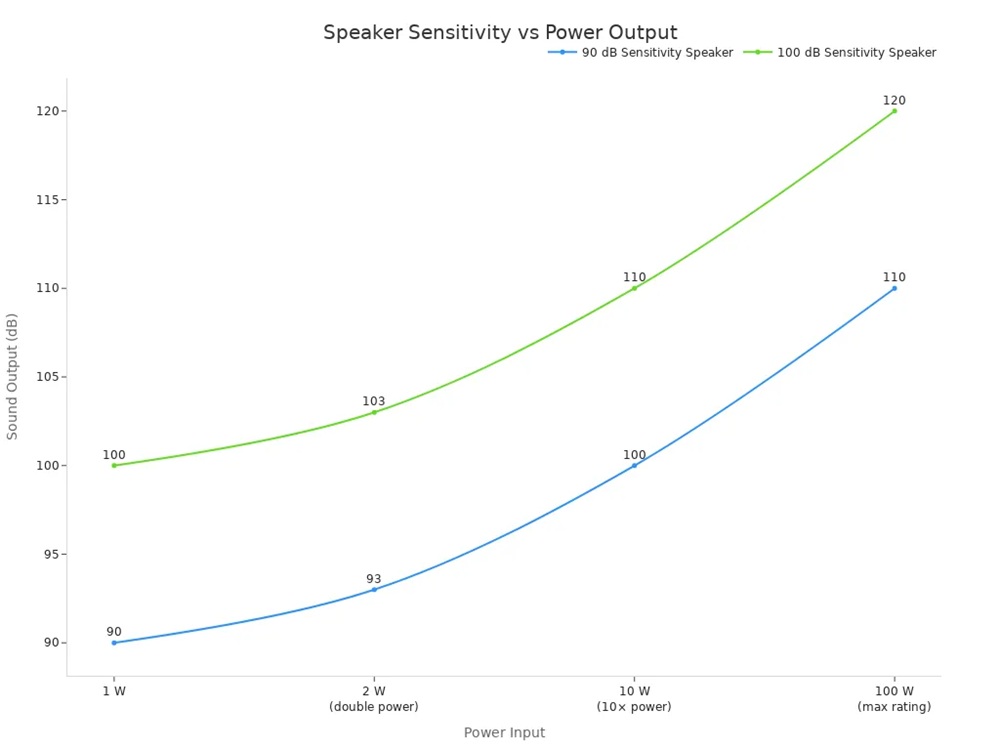
The pattern is clear. A 10 dB higher sensitivity rating yields 10 dB more output at every power level. The higher-sensitivity speaker reaches a given loudness with one-tenth the power. Doubling amplifier power adds only 3 dB, and a tenfold increase doubles perceived loudness. Sensitivity, not wattage, drives your power needs.
Your listening habits set the target sound pressure level. Most casual sessions sit around 65–70 dB, with peaks in the low 80s. Critical listening often references 83 dB. Loud rock sessions can push past 100 dB at peaks.
|
Listening Type |
Reported dB Level |
|
Casual listening (average SPL) |
65–70 dB |
|
Regular listening |
up to 85 dB |
|
Critical listening (reference/mixing) |
83 dB SPL |
|
Rock music (typical range) |
83–90 dB |
|
Orchestral (peaks) |
usually ≤94 dB |
|
Loud/rock-out sessions |
90–92 dB with peaks over 100 dB |
Every 10 dB increase in loudness demands roughly ten times the power. Decide your realistic peak level before you size your amplifier.
Floor area alone misleads you. Cubic volume, meaning length × width × height, determines how much air your speakers must move. A 200 sq ft room with a standard 8-foot ceiling holds 1,600 cubic feet. The same footprint with a vaulted 14-foot ceiling holds 2,800 cubic feet, nearly double the air. Open doorways and adjoining spaces add effective volume too. Measure your ceiling height and note any open boundaries. Use cubic volume, not square footage, as your true room-size input.
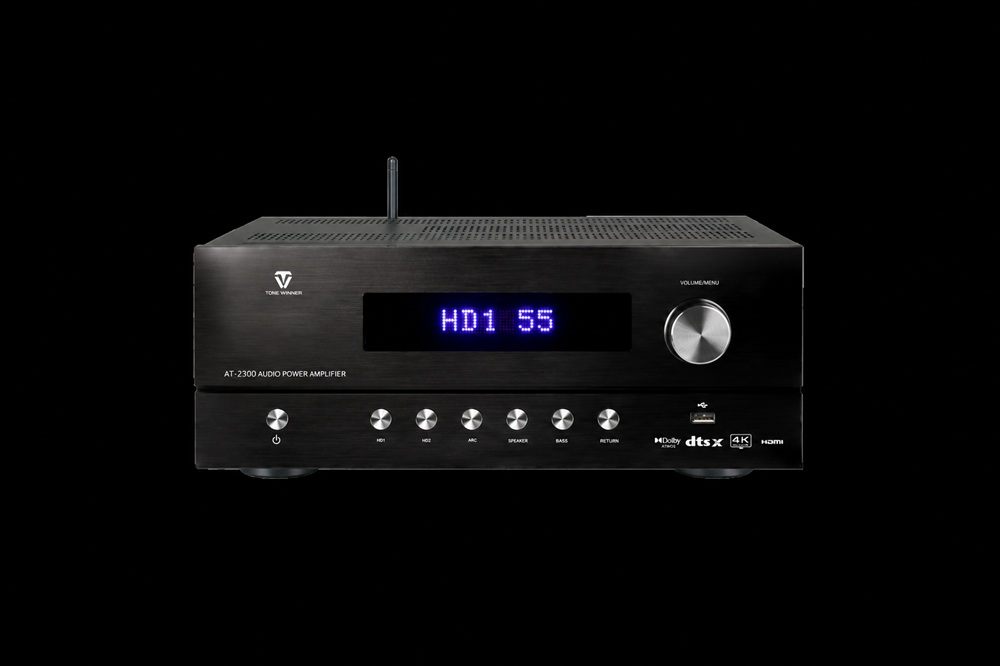
The full table expands the quick rule into practical ranges. Each room size gets a wattage band, a typical listening distance, and a note on what drives the number. Use this table as your working reference. Find your room, read across, and set your target.
|
Room Size |
Typical Floor Area |
Recommended Watts per Channel |
Typical Listening Distance |
Notes |
|
Small |
Under 150 sq ft |
20–50 W |
6–8 ft |
Near-field setups, desks, bedrooms |
|
Medium |
150–300 sq ft |
50–100 W |
8–12 ft |
Most living rooms and dedicated listening rooms |
|
Large |
300–600 sq ft |
100–200 W |
12–16 ft |
Big living rooms, basements, studios |
|
Open-concept / very large |
600+ sq ft or open boundaries |
200 W+ or high-sensitivity speakers |
16+ ft |
Adjoining spaces add effective volume |
The bands assume average-sensitivity speakers (85–89 dB) and peaks around 85–95 dB. Your speaker rating and listening habits shift the target. A high-sensitivity speaker can drop you one band. A low-sensitivity speaker can push you up one band. Treat the table as your starting point, then fine-tune.
Small rooms need the least power. A typical bedroom, office, or near-field desk setup sits under 150 square feet. Your listening distance stays short, often 6–8 feet. Short distance means the direct sound dominates and reflections stay modest. You reach your target loudness with very little amplifier output.
A 20–50 watt per channel range covers most small-room systems. A pair of average-sensitivity bookshelf speakers at 8 feet needs only a few watts for casual listening at 70 dB. Peaks at 85 dB still demand well under 20 watts. The extra headroom in the 20–50 W band protects you during dynamic passages and gives your amplifier room to breathe.
Small rooms reward clean power over raw wattage. A Tonewinner receiver with honest ratings delivers the low-wattage precision this space needs. Distortion stays low at the modest levels you actually use. You gain nothing from a 200-watt amplifier in a 120-square-foot room. You gain clarity, control, and a lower noise floor from a well-built amp in the 20–50 W range.
Watch one trap in small rooms. Close walls boost bass through room gain. This boost can mask distortion and make you push the volume higher than needed. Set your target level first, then confirm your amplifier stays clean at that level. The small-room band gives you plenty of margin.
Medium rooms form the most common case. A standard living room or a dedicated listening room lands in the 150–300 square foot band. Your listening distance grows to 8–12 feet. That extra distance costs you loudness, and the larger air volume adds more work for your speakers.
The 50–100 watt per channel range fits this space well. At 10 feet, an average-sensitivity speaker loses roughly 6 dB compared with one meter. You need more power to hold the same level. Casual listening at 70 dB still uses only a handful of watts. Dynamic peaks at 90–95 dB push the demand higher, and the 50–100 W band covers those peaks with headroom to spare.
This band is where the wattage decision pays off most. Too little power forces your amplifier into clipping during loud passages. Too much power wastes money and adds cost you never hear. A Tonewinner receiver in this range gives you clean output at the levels a medium room actually demands. The honest power rating matters more here than the headline number.
Measure your room before you buy. A 250-square-foot room with a vaulted ceiling behaves like a larger space. A 280-square-foot room with a standard ceiling and closed doors behaves like a smaller one. Use cubic volume as your guide, then pick your spot inside the 50–100 W band.
Large rooms demand real power. A big living room, a finished basement, or a home studio in the 300–600 square foot range stretches your amplifier. Listening distance climbs to 12–16 feet. The air volume grows fast, and your speakers must move far more air to reach the same sound pressure level.
The 100–200 watt per channel range suits this space. At 14 feet, the distance penalty is steep. An average-sensitivity speaker needs substantially more power to hit 90 dB peaks than it did at 8 feet. The 100–200 W band gives you the headroom to handle dynamic music and movie soundtracks without strain.
Headroom is the key word here. A 100-watt amplifier running near its limit sounds compressed and harsh. A 150–200 watt amplifier running at half its capacity stays clean and relaxed. The extra watts buy you composure, not just volume. A Tonewinner receiver with genuine high-power output delivers that composure in a large room.
Large rooms also expose weak amplifiers. Clipping becomes audible at lower levels because you push the amp harder. Choose an amplifier with honest ratings and solid thermal design. The 100–200 W band only helps if the watts are real and clean.
Open-concept layouts break the simple room-size rule. A 400-square-foot living area that opens into a kitchen and hallway behaves like a much larger space. Sound escapes into adjoining zones, and the effective volume can double or triple. Your amplifier now fills a space far bigger than the floor plan suggests.
These spaces need 200 watts per channel or more, or a shift to high-sensitivity speakers. High-sensitivity designs (90 dB and up) let you reach the same loudness with far less power. That trade-off often beats buying a bigger amplifier. A 95 dB speaker needs roughly one-tenth the power of an 85 dB speaker for the same output.
Open boundaries also change the acoustics. Reflections arrive from many directions, and the diffuse field stays fairly constant across the listening area. The direct sound still drops with distance, so your main listening seat sets the real demand. Measure from your seat to the speakers, not from wall to wall.
Very large dedicated spaces, such as a home theater room over 600 square feet, follow the same logic. Target 200 watts per channel or higher with average-sensitivity speakers. Consider multiple subwoofers and room treatment to manage bass. A Tonewinner receiver with robust multi-channel power gives you the foundation for these demanding rooms. Match the amplifier to the true cubic volume, and the system stays clean at every level you use.
Speaker sensitivity changes your wattage target more than room size does. A 10 dB sensitivity difference shifts your power need by a factor of ten. Read your speaker's rating, then adjust the room-size table up or down.
High-sensitivity speakers need very little power. A 90 dB rating means one watt produces 90 dB at one meter. You can fill a medium room with a fraction of the wattage the table suggests.
|
Speaker Sensitivity |
Sufficient Watts per Channel |
Room Context |
|
Very high (92–95 dB) |
5–10 W (tube amps, incl. single-ended) |
Small to medium rooms |
|
Ultra-high (95–100+ dB) |
2–5 W (very low-power amps) |
Useful when sitting far away, still achieving live-like peaks |
|
~90–92 dB |
10–20 W |
Provides extra headroom for peaks in medium rooms |
A 95 dB speaker runs on 2–5 watts in most rooms. A 90–92 dB speaker benefits from 10–20 watts for peak headroom. You gain nothing from a 100-watt amplifier here. Clean low-power output from a Tonewinner receiver suits these designs well.
Average-sensitivity speakers follow the room-size table directly. The 85–89 dB band covers most home speakers. Use the 20–50 W, 50–100 W, and 100–200 W bands as written. Your listening distance and target level fine-tune the number inside each band.
Low-sensitivity speakers demand more power. An 83 dB speaker needs roughly double the wattage of an 88 dB model for the same loudness. Move up one band from the table. A medium room now calls for 100–200 watts per channel. Choose an amplifier with honest high-power ratings and solid thermal design. A Tonewinner receiver with genuine output keeps these speakers clean at realistic levels.
Movie soundtracks push your amplifier harder than music does. Explosions, crashes, and dynamic peaks arrive suddenly and demand instant power. A music track spreads its energy across time. A film soundtrack concentrates energy into short bursts. You need headroom to reproduce those bursts without clipping. Aim for 20–30% more wattage than your music-only target. A medium room that needs 50–100 watts for music calls for 100 watts or more per channel for film.
The AT-2700 7-channel Dolby Atmos receiver delivers honest power across seven channels. Match its output to your room size and speaker sensitivity. Use the table below as your guide.
|
Room Size |
Target Watts per Channel |
AT-2700 Fit |
|
Small |
20–50 W |
Comfortable headroom |
|
Medium |
50–100 W |
Strong match |
|
Large |
100–200 W |
Clean at high levels |
The AT-2700 7-channel Dolby Atmos receiver suits medium and large rooms well. Check your speaker sensitivity first. High-sensitivity speakers need less power from the AT-2700 7-channel Dolby Atmos receiver. Low-sensitivity speakers benefit from its full output.
Tonewinner builds receivers with honest power ratings. The AT-2700 7-channel Dolby Atmos receiver gives you real watts, not inflated numbers. You get clean output at the levels your room demands. That honest power protects your speakers and your ears.
Three myths drive most bad wattage decisions. Clear them up and you can size your system with confidence.
Extra watts only help when your system needs them. A 200-watt amplifier in a small room delivers no audible benefit over a clean 50-watt unit. Sound quality depends on clean output, low distortion, and a strong power supply. Tonewinner builds receivers with honest ratings, so the number on the box reflects real performance. Buy watts your room can use, not watts that impress a spec sheet.
Doubling power adds only 3 dB, which most listeners hear as "a little louder." Twice the perceived loudness requires ten times the power. The table below shows the real math.
|
Perceived Loudness Change |
Power Multiplier Required |
|
1 dB (barely noticeable) |
1.26x |
|
3 dB ("a little louder") |
2x |
|
6 dB (significantly louder) |
4x |
|
10 dB (twice as loud) |
10x |
|
20 dB (movie headroom) |
100x |
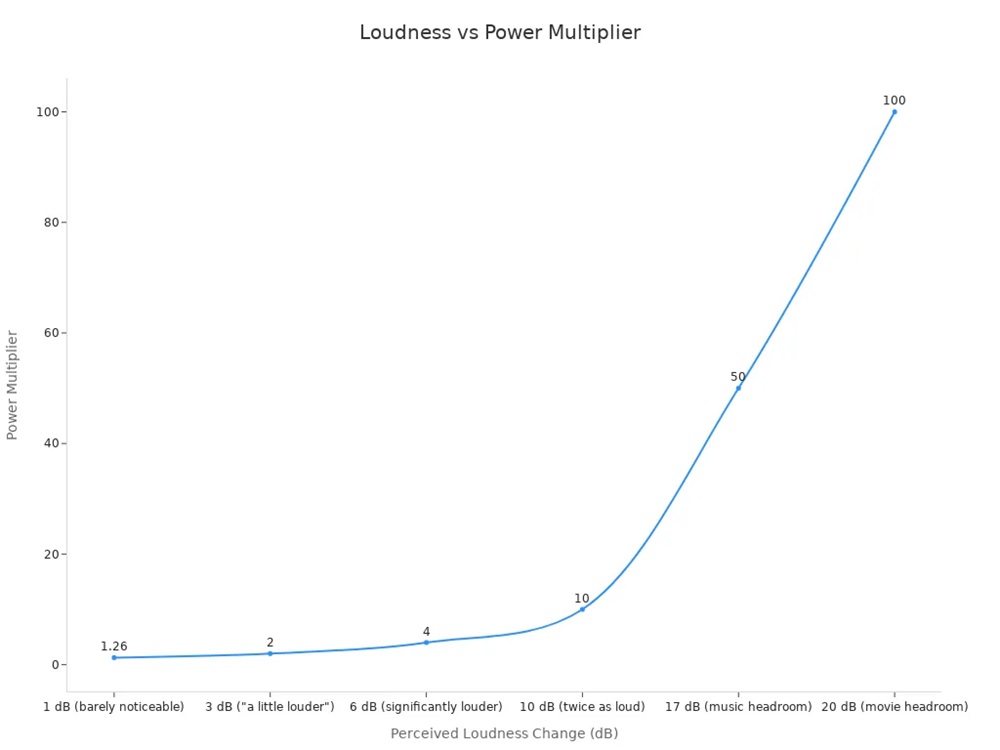
This logarithmic curve explains why chasing volume with wattage wastes money. Speaker sensitivity moves the needle far more than amplifier size.
An underpowered amplifier can destroy speakers through clipping. When the amp runs out of voltage, waveform peaks flatten into a DC-like signal. That pulsed DC passes through crossover capacitors and burns voice coils. Low-impedance speakers make the risk worse, because the amp may clip well below its rated power.
Match your amplifier to your speaker's recommended power range. Too little power damages speakers more often than too much.
Check your speaker's minimum and maximum power handling before you buy. A Tonewinner receiver with genuine output keeps you inside that safe window.
Match watts to room size first, then fine-tune for speaker sensitivity and listening habits. Remember that 50 clean watts beat 200 distorted ones every time. Tonewinner builds the AT-2700 7-channel Dolby Atmos receiver to deliver honest, clean power for real-world rooms. Check your speaker's sensitivity rating and room dimensions today, then use the table to pick your target wattage. The AT-2700 7-channel Dolby Atmos receiver gives you a reliable starting point for that match.
Check the spec sheet, the manual, or the label on the back of the speaker. Look for a dB figure measured at 1 watt and 1 meter.
No. You control the volume, so extra watts stay unused. Clean headroom helps, and Tonewinner receivers deliver honest power at low levels.
Yes. A medium room calls for 50–100 watts per channel. The AT-2700 7-channel Dolby Atmos receiver matches that range with clean, honest output.
Tel : +86 020 3479 6146
Tel : +86 020 3479 7660
WhatsApp : +86 15812388120
Email : simi@tonewinner.com
Address : Building 2, No.1, Hongsheng 3 Road Dashi Street, Panyu District Guangzhou, 511430 China
© 2026 Guangzhou Tonewinner Electronics Co., Ltd
Sitemap | XML | Privacy Policy |